




How a Multistage Pump Works:
After entering the pump, the fluid enters the first stage. The operation of each stage is exactly like a conventional centrifugal pump. The impeller transfers energy to the fluid, increasing its speed and pressure. Due to the centrifugal force, the fluid moves outward from the impeller and exits it.
Then, the fluid enters the diffuser and its pressure increases. After exiting the first stage, the fluid enters the second stage, but the inlet conditions in the second stage are different, and the fluid pressure has increased; therefore, in the second stage, the impeller can increase the fluid pressure by another step by transferring energy. This process is repeated for the number of pump stages, and finally, the desired pressure is created at the pump outlet.
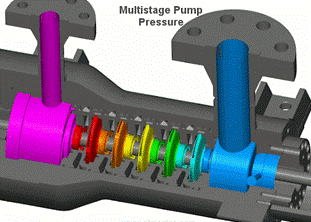
The pump has a volute shaped casing, and each impeller has its own volute. The impellers are installed symmetrically to reduce axial forces.
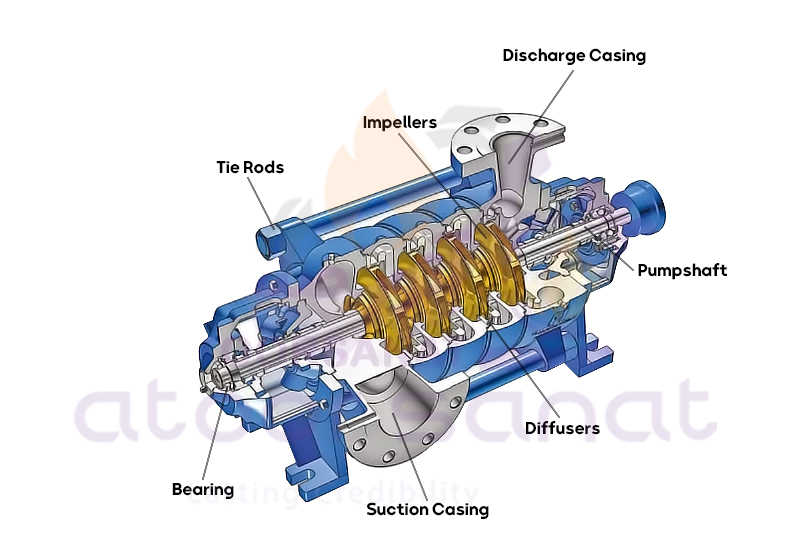
Multistage pumps are divided into two types: vertical and horizontal. The characteristics of each are discussed below.
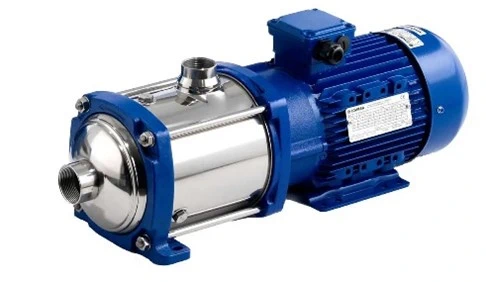
- Horizontal Multistage Pump: This type of pump has a divided casing with intermediate parts. The rotating parts are fixed between the bearings, which improves system balance at high pressures. In general, horizontal pumps can withstand higher pressures compared to vertical pumps (except for vertical turbopumps) and their flow rate is around 450 to 1500 cubic meters per hour.
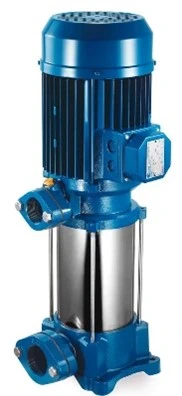
- Vertical Multistage Pump: This type of pump is one of the most common centrifugal pumps. It has a shaft on which the impellers are stacked. Vertical pumps are suitable for applications where space is limited.
Criteria for Selecting a Multistage Pump
The most important factor to determine before selecting a multistage pump is whether it should be vertical or horizontal. Paying attention to the following points can help you choose the right multistage pump.
Horizontal and vertical pumps, despite having a similar structure and function, have significant differences. The most important factor in choosing is the amount of available space. A horizontal multistage pump occupies a larger surface area while a vertical multistage pump requires a greater height. In addition, the location of the connections for each of the pumps is also different.
Maintaining vertical pumps is much more difficult. For example, before performing any operation, the upper part of the impeller must be completely removed. The installation of each of the pumps is also different. A vertical pump is installed as a single unit, which makes the installation easier, but installing a horizontal pump is more difficult and requires various adjustments after installation.
Multistage pumps are specially named based on the features they offer in industrial applications. In this section, the characteristics of each type of pump are explained.
Type D: This pump is a single-suction type and is used for transferring water or fluid with physical and chemical properties similar to water. The fluid temperature in this type should not exceed 80 degrees Celsius and, in general, this pump is suitable for factories, mines, irrigation, and water supply for urban and rural areas.
Type DG: Like the previous type, this pump is also single-suction and the maximum temperature of the pumped fluid is 105 degrees Celsius. This type is suitable for various fluids and low-pressure boiler feed water.
Type DM: This type is based on the Type D pump with some design changes. The DM pump can pump fluids with up to 1% impurities and solid particles up to 0.1 mm. If the materials in contact with the fluid are corrosion-resistant, this pump is suitable for transferring acids and weak corrosive fluids. The maximum acceptable temperature for the fluid is 80 degrees Celsius. This pump is usually used for applications such as feeding mine water, drainage, pumping various raw materials for the production of sugar, steel, and paper, and applications such as wastewater transfer.
Type DF: This pump is single-suction and corrosion-resistant and is used for transferring fluids without solid particles. The allowable fluid temperature is -20 to 105 degrees Celsius and the inlet fluid pressure is a maximum of 6 bar. This pump is mostly used for transferring chemicals, petroleum products, various paints, drugs, and in applications such as metallurgy, small industries, environmental protection, desalination processes, and offshore and mining oil extraction.